


As we mark the centenary of the two-day weekend, many believe it is time to rethink our calendars.
“Very few people alive today can recall a time before the establishment of a five-day work week and a two-day weekend,” commented Grace Tallon, co-founder of Work Time Revolution, a consultancy in Toronto that assists companies in transitioning to shorter work hours.
Historians and advocates for reform in work schedules highlight that significant changes have occurred since the two-day weekend became a norm roughly a hundred years ago, varying by region worldwide.
Tallon emphasizes that only 20 percent of women were part of the workforce back then. “Currently, we predominantly have dual-income families, yet we still face a five-day work week that does not really cater to families,” she stated.
Experts also remind us that the concept of the weekend is a human invention that has adapted in the past and can adapt once more.

Grace Tallon, co-founder of Work Time Revolution, states that our living and working styles have transformed significantly since the last review of the workweek length. (Submitted by Grace Tallon)
The origins of the two-day weekend
During the late 19th and early 20th centuries, long working hours were common.
“Essentially, if you were a wage worker, the standard work week consisted of six days at ten hours each,” explained Craig Heron, a labour historian and professor emeritus at York University in Toronto.
“The weekend originated with Sunday being a day off for religious observance,” Heron shared with Cost of Living host Paul Haavardsrud.
While Henry Ford is often recognized for implementing the two-day weekend, the narrative is more complex, rooted in decades of labour movement efforts.
Before Ford’s introduction of a five-day work week, small groups of workers had already made strides toward similar reforms.
“The printers were among the most notable groups,” Heron noted. “They succeeded in establishing an eight-hour workday by around 1910.”
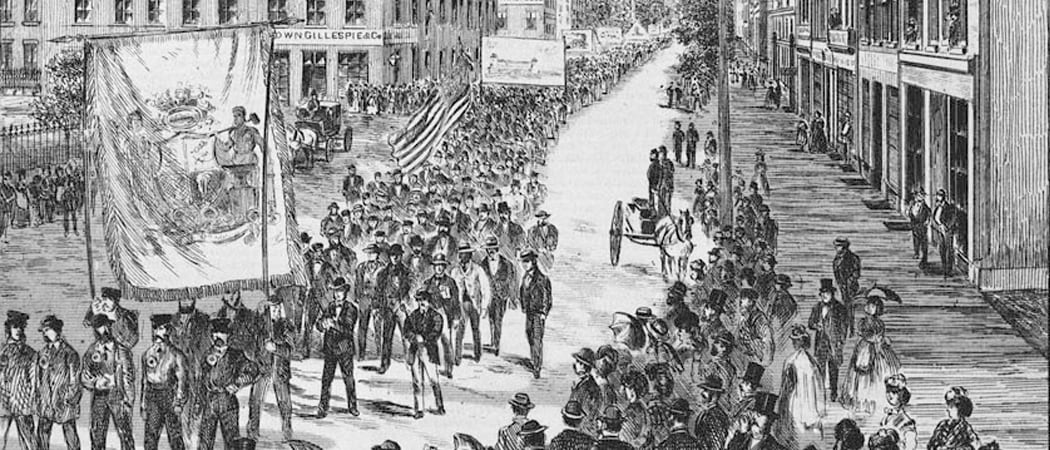
An illustration from the Canadian Illustrated News depicts workers participating in a Nine-Hour Movement protest in Hamilton, Ontario, in 1872. This movement advocated for shorter working hours and played a crucial role in significant updates to Canadian labour laws. (Canadian Illustrated News/Library and Archives Canada)
When Ford declared in October 1926 that his factories would adopt a five-day work week, it marked the first time a major U.S. employer did so.
In the same month, the American Federation of Labor passed a resolution at its annual conference advocating for a five-day work week, according to Heron.
However, it took time for the two-day weekend to gain widespread acceptance, including in Canada, he adds.
Initially, many workplaces across North America and beyond reduced Saturday’s working hours to half a day.
The labour movement grew more robust in the 1940s as World War II increased the demand for labour, which empowered unions to secure shorter workdays through significant strikes, he explained.
This prompted governments to pay attention and implement relevant legislation.

Participants in workplaces that have implemented programs to reduce hours while maintaining pay through pilots conducted by the non-profit 4-Day Week Global reported enhancements in their ability to balance work with their social lives. (Tint Media/Shutterstock)
The evolution of work
Since then, the dynamics of work have dramatically changed, which can influence whether a two-day weekend is perceived as sufficient.
“Today, many individuals have a more flexible work schedule, often working electronically at all hours and being available at any time,” remarked Heron. “Their phones can ring at any moment because of their employer’s needs.”
While work hours gradually decreased from the late 19th century until the mid-20th century, they began to rise again afterward, noted David Henkin, a historian at the University of California, Berkeley, and author of The Week: A History of the Unnatural Rhythms That Made Us Who We Are.
The blurring of lines between work and personal life has not only led to an increase in work volume but has also diminished the “psychic insulation” individuals have from their jobs, he adds.
Transforming weekends into long weekends
The desire to counteract this erosion is one of the driving forces behind the push for a four-day workweek.
Tallon, who has previously served as the executive director of the non-profit 4-Day Week Global, which initiated trials for a four-day workweek starting in 2022, reported that all 41 companies involved in Canada and the U.S. continued with the four-day week after their six-month assessments concluded.
Among these was Praxis, a public relations firm based in Toronto.

Meredith Nebel, an account director at Praxis, mentions that since the firm transitioned to a four-day week, she has been able to reserve her weekends for family time, as she can complete errands, chores, and appointments on Fridays. (Submitted by Meredith Nebel)
Meredith Nebel, an account director at Praxis, explains that days off are staggered. Her colleagues manage her responsibilities while she is off on Fridays, “and then I take over their Monday tasks to ensure there’s no disruption in workflow.”
-
These Canadian companies switched to a 4-day work week. Here’s why
-
Why experts say it’s time to adopt a 4-day work week
Nebel believes she could not return to a five-day week.
“I enjoy more moments with my children. I have time for my community. I have greater opportunities to focus on my own life and personal growth,” she expressed.
Nebel utilizes Fridays to take care of appointments, errands, and chores, ensuring weekends are available for family activities and her children’s engagements.
Charles Latimer, who is employed by Greenpeace, mentions that having Fridays off since the organization transitioned to a four-day week has allowed him time for volunteering.
“I recently started a children’s basketball program after daycare on Tuesdays,” said Latimer, who works remotely from Lund, British Columbia, around 200 kilometers north of Vancouver.
On Fridays, he handles administrative tasks for the program and looks after his four-year-old kid, he explained.

Charles Latimer, pictured here with his four-year-old daughter and their dog, serves as head of strategic integration for Greenpeace, which has implemented a four-day work schedule. (Submitted by Charles Latimer)
Consultant Grace Tallon notes that switching to a four-day schedule requires significant planning. “This might involve restructuring meetings; ensuring everyone has uninterrupted work time, which may not have been previously prioritized.”
At Praxis, Nebel reports that completing tasks in a shorter timeframe has not posed a challenge.
“Work tends to expand to fit the time allotted,” she stated, “but with four days, a natural urgency emerges, leading us to plan more strategically and focus on what truly requires completion.”
‘The week is not a natural construct’
We often perceive the week — comprising five workdays and two days of rest — as immutable.
However, Henkin argues that the concept of the week, and how we partition it, is significantly more arbitrary than other time measurement units.
“The week is unnatural since it isn’t grounded in any astronomical cycles that create days, hours, or years, nor is it linked to biological rhythms that create patterns of day and night.”
Tallon asserts that whether a business is contemplating a four-day week or simply aiming to control long hours, it revolves around “how to begin valuing your own time and how the organization comes to honor that time.”
“Consequently, many individuals feel, ‘I can mute my notifications in the evening. I won’t check [because] I feel I must. Because nothing catastrophic will occur.'”