

With rising worries about AI agents acting unpredictably, experts and stakeholders are calling for increased governmental regulation of AI systems as they grow in sophistication.
However, some professionals argue that the necessity for international collaboration and the swift evolution of AI technology may complicate these efforts.
While certain figures, such as U.S. President Donald Trump, express confidence in tech companies managing their own oversight, other industry leaders, including Microsoft co-founder Bill Gates and AI pioneer Geoffrey Hinton from Canada and the UK, contend that AI necessitates regulatory measures that extend beyond self-governance.
Jaxson Khan, who specializes in AI policy and its implementation at the Munk School of Global Affairs, University of Toronto, stated that since virtually all other sectors, like food production and aviation, are subject to some form of government oversight, it’s only logical that AI should be as well.
“In no significant industry do we allow companies to completely regulate themselves, be it oil and gas, food production, or nuclear energy,” he remarked.
-
Bill Gates joins call for AI safeguards, wants to discuss concerns with Trump
-
Is AI evolving too fast? A look at the debate on slowing it down
“Having such a potent technology entirely in private hands, at least without oversight, seems quite unusual compared to how our economy and regulatory frameworks generally function,” he added.
In a recent interview with CBC News Network, Hinton proposed that an official agency, akin to the U.S. Food and Drug Administration, could oversee AI regulation.
“You can’t simply create a drug and market it in the U.S. You need to convince the FDA that your drug is safe, or at least that its benefits outweigh its risks, and companies are accountable for that,” he explained.
“We definitely need something at least as robust for AI. We should have independent evaluators assessing it, and companies must meet the criteria set by those evaluators before releasing their products.”
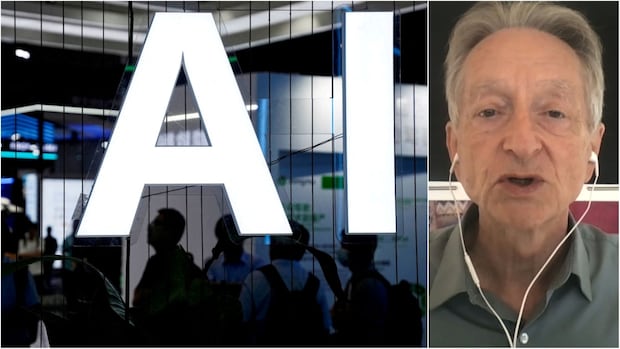
U.S. President Donald Trump is hosting a summit in Washington with the top leaders in AI development. Trump has dismissed warnings over artificial intelligence, arguing for the need to stay ahead of China in the AI arms race. Geoffrey Hinton, who is considered the ‘godfather’ of AI, says Trump ‘doesn’t really understand’ AI and is ‘ill-advised’ about it.
Hard for governments to keep upÂ
Khan indicated that a major obstacle to AI regulation is the rapid evolution of models.
An Anthropic report recently revealed that the capabilities of its AI agents double approximately every four months. Furthermore, there is increasing evidence suggesting that certain AI models possess the ability to recursively enhance themselves, allowing them to create and design their own successors, according to the report.
“I don’t think we’ve ever encountered a technology of such potency that changes this rapidly,” he stated.
This rapid progression makes it challenging for governments to keep pace, noted Manon Paquet, associate director of policy at McGill’s Centre for Media, Technology and Democracy.
“It’s extremely difficult to regulate something you don’t fully comprehend yet,” Paquet stated.
“As a former public servant, I feel sympathy for my colleagues in Ottawa who are grappling with these issues, as the speed of change means that by the time regulations or legislation are proposed, the problem has already transformed into something different.”

Silicon Valley tech CEOs are calling for a slow down of artificial intelligence development â but is that even possible? For The National, CBC’s Ashley Fraser looks at what it would take to pace the AI race and why experts say it won’t be easy.
Global oversightÂ
Several experts and leaders, including Prime Minister Mark Carney, have advocated for the establishment of a global, non-industry organization to oversee and mitigate the risks associated with AI technology on an international scale.
Earlier this week, around 400 scientists, including Hinton and fellow AI pioneer Yoshua Bengio, called for an international entity to manage containment standards and incident reporting for advanced AI systems capable of cyber operations.
This proposed organization would maintain a registry of significant security incidents, which the scientists believe should ultimately be made public.
Although achieving consensus among countries on AI governance may be challenging, such an organization could facilitate collaboration among nations to “strengthen our respective systems” and establish protections against potential AI misuse, Khan explained.
“I believe stability is crucial here, even if we don’t reach an ideal model for global governance,” he stated.
However, since the majority of AI advancements originate from the United States and China, those nations must commit to participating in such a body and complying with its regulations for it to be effective, according to Olivier Blais, vice-president of artificial intelligence at Moov AI in Montreal.
“If we cannot persuade the countries where AI systems are developed, the impact may be minimal,” he warned.
Nonetheless, such an organization could aid in formulating international guidelines for safe AI practices, he added.
“It’s vital to grasp the components of a secure AI system and the areas that require restraint, and a global entity could spearhead this effort and establish the groundwork,” he noted.
Recently, the U.S. and China agreed to engage in discussions concerning the risks and advantages of AI technology, with the next meeting scheduled for November, as stated by both the Chinese Foreign Ministry and the White House.
In a separate announcement, the Chinese ministry emphasized the need for both sides to enhance communication and strive for agreement in accordance with new advancements as AI technology progresses.
AI regulation in CanadaÂ
At present, Canada lacks comprehensive federal regulations governing AI, though the Liberal government’s proposed Bill C-34, the Safe Social Media Act, outlines requirements for AI chatbots, including the necessity to mitigate the risks of generating harmful content.
Carney has also recently introduced a new national council focused on artificial intelligence, aimed at advising the government on its AI strategy and enhancing the safety of the technology.
Nevertheless, Paquet cautioned that it may be “very, very challenging” for federal legislation to be effective, given that many leading AI firms operate outside Canada.
-
Ottawa launches new national AI council to advise on safety, deployment
-
Canada is investing $150M to make AI safer. Will it work?
Blais mentioned that even if the federal government lacks the authority to regulate the operations of these companies, it could implement policies mandating them to report incidents affecting Canadians and hold them accountable. In severe cases, the government might even restrict access to AI platforms deemed excessively harmful, he added.
“At the very least, if we can document various incidents and report on them, it would be a significant advancement, as it would allow us to inform citizens and demonstrate leadership,” he concluded.