

At this year’s Paris auto show, Europe’s automotive giants, Stellantis and Volkswagen, showcased their increasing assurance in electric vehicles by taking cues from their Chinese counterparts, who are currently transforming the European market.
Both manufacturers are implementing strategic changes to combat the intensifying competition posed by Chinese companies in Europe. However, Stellantis’ announcements on Monday indicated a greater potential for collaboration.
-
Stellantis is launching 11 new North American models. Could they be built in Canada?
-
Stellantis talks to build Chinese EVs in Brampton are ‘unacceptable’: Ontario premier
The French-Italian auto manufacturer, which includes brands like Citroen, Peugeot, Opel, and Fiat in Europe, is leveraging its partnerships with Leapmotor and Dongfeng to analyze the technological advantages held by Chinese firms, as stated by Stellantis CEO Antonio Filosa during a press briefing.
Filosa remarked, “I don’t entirely concur with the notion that we lack essential capabilities, but there are certainly areas where we can complement each other.”
“Through collaboration and integrating our engineering teams, we can better understand our competitive advantages and learn from them,” he added.
Accelerating with Chinese Collaborators
Earlier this year, Stellantis formed a production partnership with Leapmotor and is planning another with Dongfeng, marking a strategic pivot under Filosa—these alliances will be localized to comply with upcoming “Made in Europe” regulations.
The shift towards electric vehicles in Europe has gained momentum recently, driven by increasing fuel costs and more competitively priced options from both Volkswagen and Stellantis’ mainstream brands. Both companies are striving to maintain their market presence as Chinese manufacturers rapidly expand internationally to offset declines in their domestic market.
Danilo Annese, CEO of Leapmotor International—a joint venture led by Stellantis—commented, “We are witnessing unexpected traction for battery electric vehicles (BEVs), even in countries like Italy and Spain where adoption has been slower.”
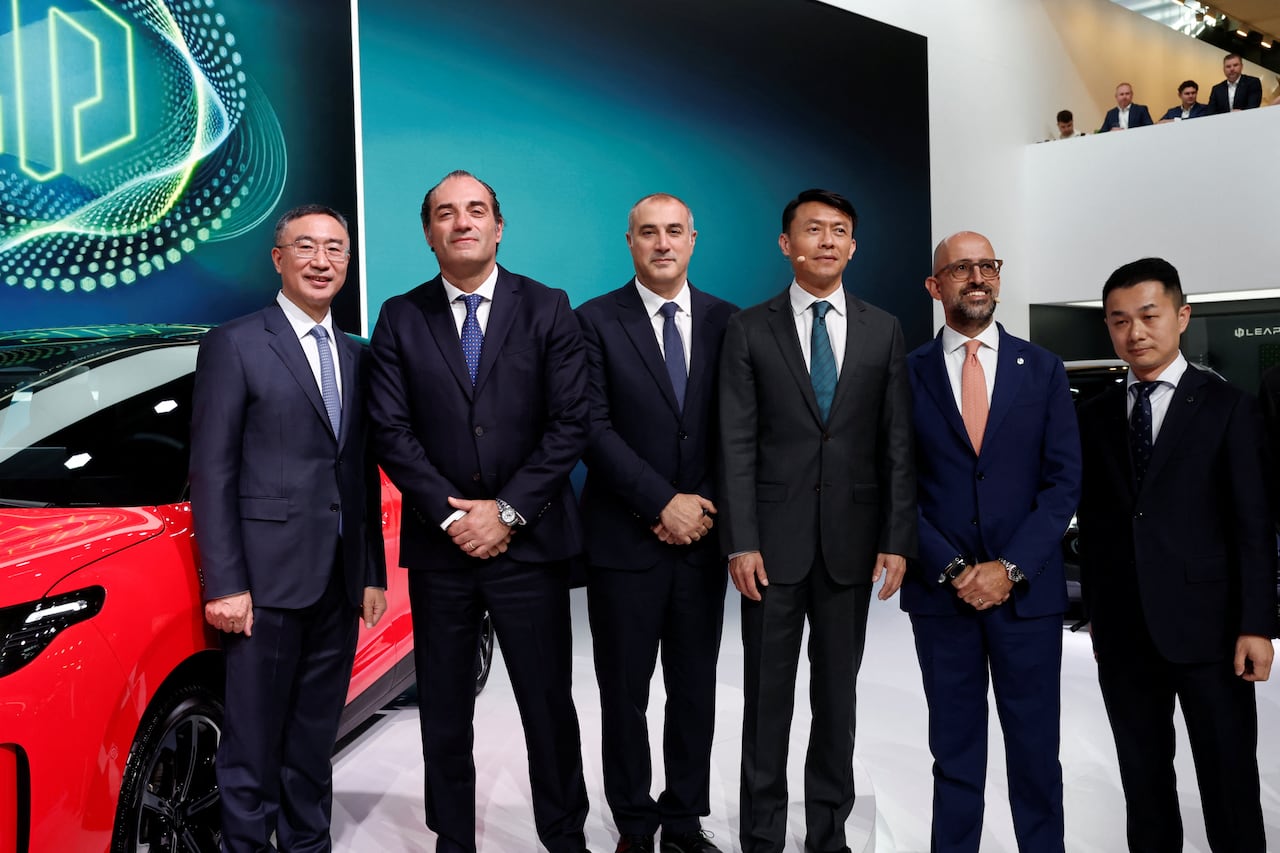
Executives at Leapmotor and Stellantis pose together on the showroom floor of the 2026 Paris Auto, Oct. 12, 2026. (Benoit Tessier/Reuters)
Stellantis’ collaboration with Leapmotor encompasses the development of a mid-sized electric SUV, created by the Chinese EV manufacturer in conjunction with Opel, the German brand of Stellantis.
Opel CEO Florian Huettl praised the project’s rapid progress, noting it as a rare instance of a Western automaker leveraging a Chinese partner to bring new vehicles to market within a two-year timeframe.
Additionally, Stellantis revealed a series of concept vehicles at the Paris show as part of Filosa’s initiative to refresh its model offerings. However, Felipe Munoz from Car Industry Analysis pointed out that the automaker still faces pressure to catch up with the fast-evolving Chinese market. “They need to focus on production, not concepts, and they need it now, not in two years,” he emphasized.
The Learner Becomes the Educator
Volkswagen has also been significantly influenced by China, which CEO Oliver Blume referred to as a “fitness center” for the industry.
Yet, the impact in Europe has been mostly indirect. Volkswagen’s collaboration with Xpeng is primarily aimed at the Chinese market, and any potential cooperation in Europe remains largely theoretical—an idea previously suggested by Blume to utilize excess plant capacity, but concrete discussions have yet to materialize.
Potential partnerships with Chinese companies in Europe, such as allowing them access to underutilized German factories, could also present risks by aiding competitors in localizing production and adhering to regulations intended to safeguard European automakers.
-
Canada bet billions on an EV boom. Was it too much, too soon?
-
Volkswagen subsidiary delays opening of $7B St. Thomas, Ont., battery plant to 2029
During an industry conference in Paris on Tuesday, Blume expressed that he currently sees no necessity for a Chinese joint venture in Europe.
“So far, we feel adequately prepared with the opportunities we have developed over the last few years in China,” he stated.
Stefan Bratzel, an analyst at Germany’s Center of Automotive Management, noted that both Volkswagen and Stellantis “are collaborating with Chinese entities in various manners.”
While Volkswagen’s focus has been on partnerships in China, Stellantis’ alliance with Leapmotor is emerging as a successful case in Europe, he remarked.
According to Bratzel, European automakers must now recognize China’s position as “a teacher” for the time being. “For years, it was the Chinese who learned from the Germans. Now, that dynamic must shift,” he concluded.