

Cybersecurity specialists are warning that the recent cyberattack on French supermarkets, which resulted in the spoilage of hundreds of refrigerators full of food, highlights the weaknesses inherent in digital systems and internet-connected devices.
Steven Lachance, a cybersecurity expert from Montreal, stated, “As our dependence on connected technology increases, it is imperative to consider the essential aspects of security and privacy.”
The incident seemed to focus on centralized control systems enabling remote temperature adjustments for refrigerators. Cybercriminals gained access to these controls, raising the temperatures of fridges across numerous grocery stores — in some instances reaching up to 50 °C — leading to food spoilage and raising concerns over potential fire hazards.
On Tuesday, the Paris prosecutor’s office announced that its cybercrime unit was probing the extensive attack to assess the damage and identify the perpetrators. As of now, no group has taken responsibility, and there has been no ransom demand, as reported by Reuters.
Here’s a breakdown of the supermarket cyberattack and its implications regarding the susceptibility of our technology, spanning from commercial systems to domestic devices.
What transpired in France?
Ritesh Kotak, a technology and cybersecurity analyst based in Toronto, explained that store refrigerators are typically linked to the internet via a centralized panel that facilitates remote monitoring and adjustment of parameters like temperature.
Dominique Schelcher, CEO of Coopérative U, one of the impacted French grocery chains, mentioned on social media that their fridges are connected to the internet to ensure 24/7 temperature monitoring “in case of an anomaly.”
On Monday, France’s national cybersecurity agency, ANSSI, reported awareness of multiple compromised refrigerator control panels.
ANSSI identified that the targeted remote monitoring systems were produced by a Danish firm named Danfoss. The agency later noted that other systems manufactured by Copeland and Dixell were also compromised.
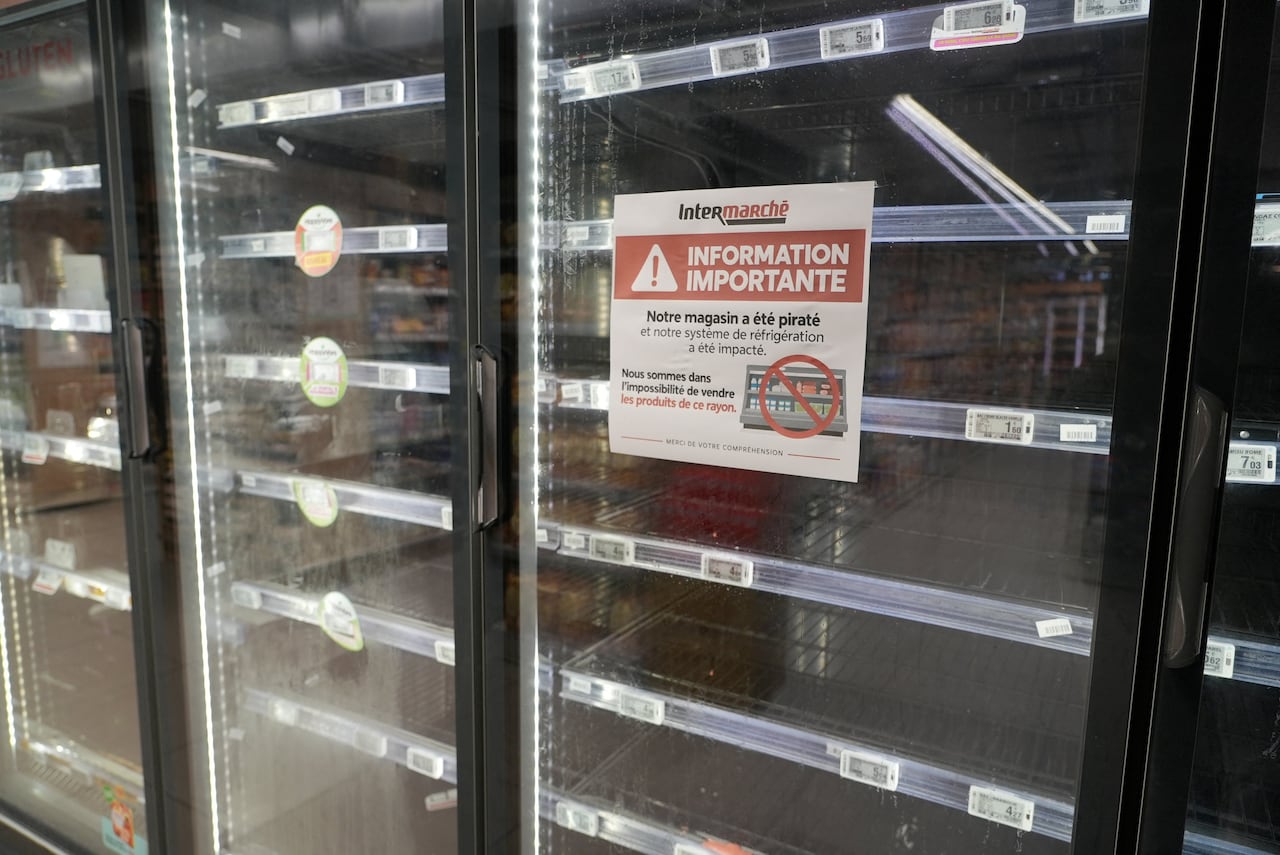
An image of empty freezers at an Intermarché supermarket in Paris on Tuesday. The notice states: “Important information. Our store has been hacked, and our refrigeration system has been affected.” (Lucien Libert/Reuters)
Danfoss informed news outlets on Monday that the compromised units were operating on “outdated firmware,” or had “reached end of life and no longer receive software or security updates.”
The cybersecurity firm Claroty issued a report in August highlighting a vulnerability in Danfoss’s firmware that could enable hackers to bypass the standard login and access the system for remote modifications. Danfoss subsequently released a fix for the vulnerability and urged users to apply it.
The company stated, “These vulnerabilities must be treated with utmost seriousness,” in its security advisory at the time.
While the precise method for hacking the fridge controllers in France remains unclear, experts suggest that a failure to implement Danfoss’s updates, alongside open internet interfaces, may have contributed.
Kotak notes that outdated firmware likely facilitated the hacking.
Firmware updates are typically issued once a vulnerability is identified; thus, when customers are informed about the need to execute an update, hackers are also alerted to the issue.
A recent EY report indicates that AI will play a significant role in cybercrime by 2026, as programs assist attackers in refining their scamming techniques.
Kotak stated, “As a hacker, you will be able to pinpoint those vulnerabilities and develop code to exploit them.”
Due to this, he emphasizes the critical need for prompt implementation of security updates.
Are such attacks on the food system frequent?
On Tuesday, French Finance Minister Roland Lescure informed parliament that approximately 700 of the 10,000 supermarkets in the country were impacted.
He confirmed that there was no threat to France’s food supply but acknowledged that the incident “strikes at the core of our food security.”
However, Kotak highlights that this is not the first cyberattack on the food distribution network. In 2021, for instance, JBS, a leading global meat supplier, was targeted by a cyberattack that briefly halted operations in Canada, the U.S., and Australia.
In 2025, United Natural Foods, Inc., a major distributor of organic products, faced an attack that caused substantial shortages at Whole Foods.
On the same day, Dutch supermarket giant Ahold Delhaize announced it was in the process of restoring systems that had been shut down following a security incident that began on Sunday night — an incident that the Dutch cybersecurity authority NCSC indicated was not related to the French supermarket hacking.
Kotak remarked, “Regrettably, this is a trend we are likely to see more often. The events in France should serve as a wake-up call that we must take this matter seriously.”

Around 9,000 universities worldwide, including in Canada, were affected by a cyberattack on the learning management platform Canvas. Institutions are now working to assess the extent of the compromised data.
The significance of the food system renders it a prime target for potential attacks, Kotak adds — and with increasing digitization in processing, packaging, and logistics, additional paths for hackers to exploit become available.
He stresses the importance of enhancing digital literacy among food businesses so they can promptly apply safety updates and react effectively to cyber incidents.
“Cybersecurity… must not be merely a checkbox task. It should be an area of continuous investment,” Kotak stated.
Which devices are at risk?
Lachance, the cybersecurity expert from Montreal, emphasizes that the situation in France should remind us that any internet-connected devices are theoretically vulnerable to hacking.
As internet connectivity becomes increasingly prevalent in various devices — both commercially and domestically through “smart” appliances like thermostats, refrigerators, dishwashers, and even light bulbs — their susceptibility grows, he notes.
“There is convenience in this centralized control,” Lachance remarked. However, “the security vulnerabilities associated with them are an escalating issue, and I believe this trend will only worsen.”

Joel Reardon, an associate professor of computer science at the University of Calgary, discussed his findings on CBC News at 6.
According to Lachance, devices capable of recording audio and video present the most significant privacy concerns. There have been instances of hacks, including one where hackers seized control of Ring cameras and used the technology to harass homeowners.
Additionally, hackers may aim to infiltrate smart devices to acquire passwords or gain access to other devices within the same network, according to Lachance.
He suggests that one solution is to avoid smart devices altogether or disconnect them from the internet when connectivity is not essential — particularly in lower-cost or budget devices where security updates may not be prioritized by manufacturers.
For devices that can record audio or video, Lachance advises keeping that data stored locally rather than making it accessible over the internet.
“That’s just leaving the door open for a break-in,” he concluded.