

On Monday, American economists Robert E. Hall and Michael Woodford were awarded the Nobel memorial prize in economics for their contributions to models that assist governments and central banks in navigating economic disturbances.
The Royal Swedish Academy of Sciences made the announcement in Stockholm, recognizing the duo for their significant impact on helping policymakers manage economic variability.
In a statement, the academy remarked, “The laureates have aided us in moderating the economy’s highs and lows.”
Hall is associated with Stanford University in California, while Woodford is linked to Columbia University in New York.
Woodford expressed his gratitude during a phone call to the committee from New York, stating: “It’s a tremendous honour, and it came as a surprise.”
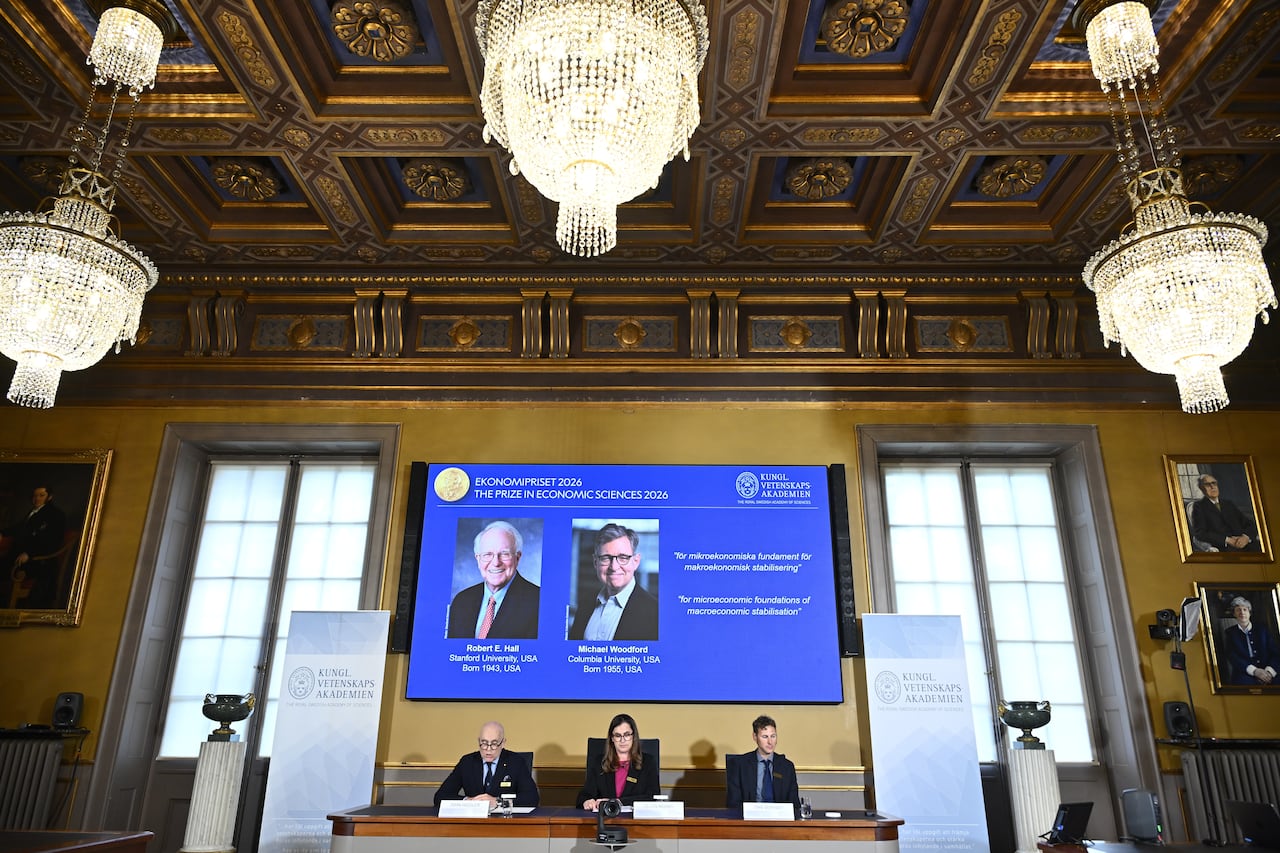
The announcement of the Nobel memorial prize in economics took place in Stockholm on Monday. Hall and Woodford received the award for their research on models that support governments and central banks in handling economic shocks. (Anders Wiklund/TT News Agency/The Associated Press)
John Hassler, chair of the Committee for the Prize in Economic Sciences, noted in a press release, “The work of the laureates has laid a solid theoretical groundwork for the models employed by central banks and governments globally.”
“Thanks to them, we are better prepared to confront economic disturbances, such as energy crises or abrupt shifts in household spending.”
‘New foundation for stabilization policy’
Historically, in response to economic disturbances, governments adhered to the approaches suggested by British economist John Maynard Keynes from the Great Depression era: intervening in the economy through tax reductions and increased government expenditure to encourage spending and investment by consumers and businesses, thereby stimulating growth.
Timo Boppart from the Nobel economics prize committee remarked, “This Keynesian formula was effective — until it was not.”
-
He won the Nobel Prize for his work understanding the brain — and his kids flipped out
-
Audio
Anne Carson just won the Nobel Prize for Literature. We learn more about her literary legacy
Economists had previously believed that managing the economy was a matter of straightforward trade-offs — for example, low unemployment would coincide with high inflation, while unemployment would increase as inflation decreased.
However, the “stagflation” phenomenon of the 1970s, characterized by simultaneous high inflation and high unemployment, demonstrated that this perspective was overly simplistic.
Hall and Woodford focused on developing a more nuanced model that accurately reflects how consumers and businesses decide on investment and spending.
“Robert E. Hall and Michael Woodford, through their individual contributions, have established a new basis for stabilization policy,” Hassler stated.
Last year, three researchers focusing on business innovation, including Canadian economist Peter Howitt, were honored for their explanations of how new products and inventions drive economic progress and improve human welfare, even as they render older enterprises obsolete.

South African jurist Navanethem (Navi) Pillay has been awarded the 2026 Nobel Peace Prize for her efforts in advancing human rights and international law. Her work has included investigations into atrocities in Rwanda, Myanmar, and Gaza, which have drawn significant criticism from Israel.
The economics award is officially referred to as the Bank of Sweden Prize in Economic Sciences in Memory of Alfred Nobel.
Established in 1968 by the central bank as a tribute to Nobel, the renowned 19th-century Swedish chemist and inventor of dynamite, it is presented alongside the other Nobel Prizes on December 10, commemorating Nobel’s passing in 1896.
Purists of the Nobel legacy emphasize that the economics prize is not technically classified as a Nobel Prize; however, it is always awarded in conjunction with the others.
Last week, Nobel recognitions were announced in the fields of medicine, physics, chemistry, literature, and peace.
This year, the monetary award for the prize amounts to 12 million Swedish kronor (approximately $1.7 million Cdn), regardless of whether it is awarded to an individual, a small group of laureates, or an organization.